According to Harvard Health Publishing, around 10 million Americans have osteoporosis. From that population, around 80% are women. It’s considered to be a silent disease because most people don’t know they have it until a minor fall leads to a fracture.1
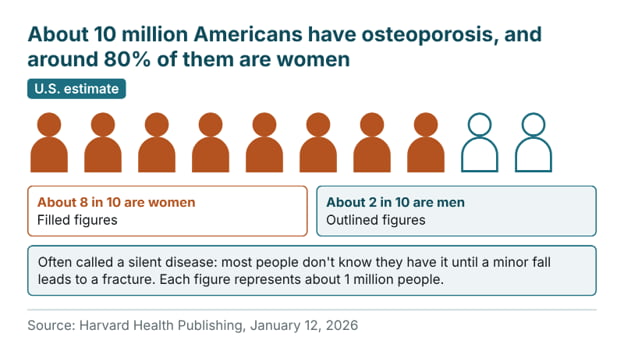
Figure 1. About 10 million Americans have osteoporosis, and around 80% of them are women.
That said, a report from The Conversation noted that lifting weights is one of the most effective exercises for bone health.2 Simply put, the right kind of movement — especially movement that loads your bones — can help your body grow stronger from a structural point of view.
Resistance Training Sends a Powerful Signal to Your Bones
In a 2018 review published in Endocrinology and Metabolism, which summarized laboratory, animal, and clinical studies, researchers noted how resistance exercise, commonly known as weightlifting, benefits both bone and muscle health, especially for older adults who are at higher risk for osteoporosis and sarcopenia — two conditions that often occur together and raise the odds of falls and fractures.3
The team highlighted resistance exercise as a promising approach, noting that it has consistently been shown to be safe and effective for improving muscle mass and strength in middle-aged and older adults. That includes frail, older adults and even people with a history of fracture — though the researchers stress that intensity need to be individualized, starting lower for anyone who is sedentary or new to this type of training.
• Many forms of resistance training may help — Using free weights, machines, or bands and doing movements like squats, deadlifts, lunges, and back extensions have been shown to help maintain or even increase bone mineral density at key sites like the hip and spine.
• Not all exercise types stimulate bone in the same way — Walking, swimming, and cycling provide benefits for your overall fitness, but according to the review, they generally do not produce the kind of intensity needed to catalyze your body’s bone-building mechanisms.
In fact, the review points out that “Regular walking, which is frequently prescribed to prevent osteoporosis, also has little or no effect on prevention of bone loss.” That’s because bones become stronger and reform only when they’re loaded with forces greater than what you experience in daily living. In short, adding weights or impact-based exercise appears to be the missing ingredient for stimulating bone growth.
That doesn’t make walking any less worthwhile. The same review acknowledges the benefits of regular walking for aerobic fitness, body fat, and cardiometabolic health. Again, its point is that walking alone isn’t enough to optimize musculoskeletal health.4 Daily walking, ideally about an hour a day, remains one of the most accessible ways to support your overall metabolic health, and adding resistance training on top of it gives your bones the extra load they need.
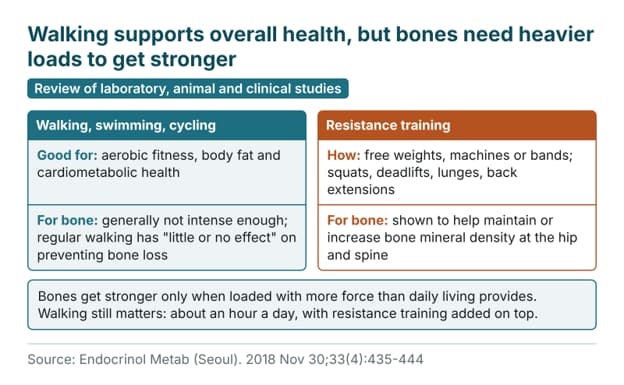
Figure 2. Walking, swimming, and cycling support overall fitness, but resistance training provides the heavier loads shown to help maintain or increase bone density.
• Best frequency for building strong bones — The authors noted that the most effective programs involved weight training at least two to three times per week, progressively increasing the resistance over time. In the studies they reviewed, high-intensity programs, using around 80% to 85% of a person’s one-repetition maximum (1RM), were associated with the greatest skeletal benefits.
In other words, simply lifting the same weight week after week is not enough. Your bones and muscles need a gradually increasing challenge to adapt. Interestingly, the spine may be more responsive to resistance exercise than the hip, suggesting that different parts of the skeleton adapt differently depending on the training.
• Intensity is key — Another noteworthy finding is that power training — lifting weights with more speed and explosive movement — maintained bone density in postmenopausal women without increasing risk of injury. This suggests that, with proper guidance, slow and cautious lifting may not be the only safe option for older adults.
Under proper supervision, power training may have a slightly greater effect on muscle strength and physical performance than regular training, and programs that include this type of exercise have improved physical status in frail older adults.
For someone worried about frailty, that suggests a potential double benefit — supporting both your bones and the muscle strength that helps keep you steady on your feet — though the researchers note that larger studies are still needed to confirm whether resistance training lowers the risk of falls and fractures.
• Safety first — While power training and other forms of medium- and high-intensity exercise may help stimulate bone growth, it’s important to practice safety, especially if you’ve already been diagnosed with osteoporosis.
The researchers note that moderate- to high-impact exercise may not be appropriate for people with severe osteoporosis or a recent fracture, so talk with your health care provider or a physical therapist about what level of training is right for you. At the same time, they point out that conventional guidelines may set the bar too low to build bone:5
“(C)urrent exercise guidelines for osteoporosis recommend only moderate-intensity exercises (70% to 80% one RM, eight to 15 repetitions) for individual muscle groups which are insufficient to generate mechanical strain to stimulate an osteogenic response.”
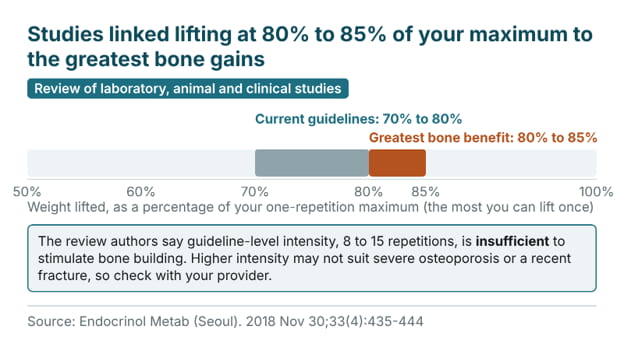
Figure 3. Current guidelines recommend lifting at 70% to 80% of your one-repetition maximum (1RM), while the review linked 80% to 85% to the greatest bone benefit.
• Why bones become stronger through exercise — Bones have specialized cells called osteocytes that act like strain sensors. When you load your skeleton with resistance, those cells detect the load and send out signals to osteoblasts, the cells responsible for building new bone.
At the same time, according to the featured review, mechanical loading also reduces production of a protein called sclerostin, which normally acts as a brake on bone growth. By lowering sclerostin, resistance exercise allows the Wnt/β-catenin pathway to stay active, keeping bone-building cells alive longer and ramping up bone formation.
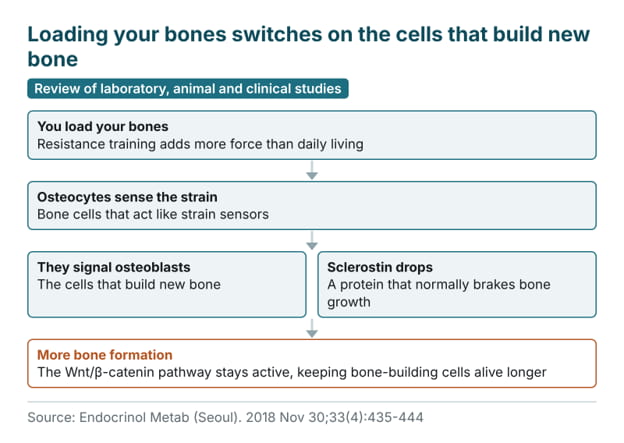
Figure 4. Loading your bones prompts osteocytes to signal bone-building osteoblasts and lowers sclerostin, keeping the bone-building pathway active.
• Consistency is key to maximizing benefits — The researchers cited a previous systematic review in which resistance exercise performed two to three times a week for one year maintained or increased bone mineral density at the lumbar spine and hip in postmenopausal women.6
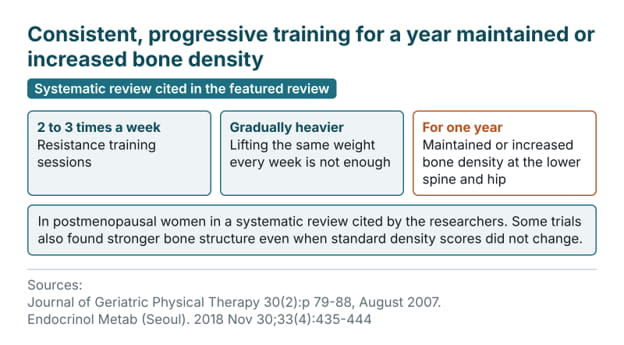
Figure 5. Resistance training two to three times a week — becoming progressively heavier — for one year maintained or increased bone density at the lower spine and hip in postmenopausal women.
• Standard bone scans may not tell the whole story — The researchers also pointed out that relying only on bone mineral density scans (such as dual-energy X-ray absorptiometry) could underestimate the benefits of training, because bone strength depends not just on mineral density but also on bone geometry and microstructure.
In some trials, even when standard density numbers did not change significantly, measures of cortical bone (the outer shell of bone) and bone geometry did improve, suggesting the bones may have become structurally stronger.
• The benefits aren’t limited to postmenopausal women — Findings showed that resistance training helped maintain or increase bone density in men as well as women, not only in postmenopausal women, who are often the focus of osteoporosis research. Studies in middle-aged and older men and in older adults showed similar results, and resistance training has been shown to be safe and effective for building muscle even in people with a history of fracture.
It’s worth knowing what kind of paper this is — a narrative review that pulls together laboratory, animal, and clinical studies, rather than a single new trial. The authors also note that there are not yet data showing that resistance exercise reduces fractures, and that larger, longer studies are still needed, particularly in older adults with low bone mass or a history of fracture.7
Try These 5 Exercises to Strengthen Your Bones
Now that you’ve read the research, it’s time to get down to the business of strengthening your bones. If routine health scans show that you’re inching closer to osteoporosis, it’s best to get your body moving now. If you’re new to lifting weights, take it slow and learn the correct technique to minimize injuries.8 That said, here are five exercises by Carrell Clinic to get you started:9
More Exercises to Supplement Your Training Regimen
Aside from the ones mentioned above, here are five additional strength exercises from Rehab Concepts Physical Therapy to help support your bone health.10 The same source also recommends checking with your doctor or physical therapist before starting a regular exercise program if you’re 40 or older.
It also provides readers with another caution — those with low bone mass should avoid sudden, jerking movements, twisting the spine to the point of strain, and lifting heavy weights. If that applies to you, start with light weights and build up gradually:
• Shoulder press
1. Stand while holding a pair of dumbbells just outside your shoulders, your arms bent, and your palms facing each other.
2. Press the weights directly over your shoulders until your arms are straight.
3. Slowly lower the dumbbells to the starting position.
• Upright rows
1. Stand with your feet around hip-width apart, shoulders back, and core braced.
2. Hold a dumbbell in each hand, palms facing towards your body, around hip-width apart.
3. Raise your elbows out to the sides to lift the dumbbells, focusing on pulling through the shoulders. As you bring the dumbbells up, maintain the same distance between each dumbbell.
4. Your shoulder mobility and anatomy can dictate how high you go. If you feel a pinch taking your elbows higher than in line with your shoulders, stop there.
5. Pause before returning the dumbbells back down.
• Bicep curls
1. While holding a pair of dumbbells down by your sides, open your hands so your palms face forwards.
2. Bending at the elbows, slowly bring the dumbbells up towards your shoulders.
3. Lower them back down until your arms are almost fully extended.
• Wall squats
1. Find a clear wall space and stand with your back against the wall. Slowly slide down the wall until your knees are bent at a 90-degree angle, or as close to it as possible. Your thighs should be parallel to the floor, and your knees should be directly above your ankles.
2. Keep your back flat against the wall and your feet planted firmly on the ground about hip-width apart. Engage your core muscles to maintain stability and support your lower back.
3. Hold this position for as long as you can, aiming for at least 30 seconds to start. As you build strength and endurance, gradually increase the duration of the hold.
4. Focus on breathing deeply and evenly throughout the exercise to help maintain endurance and relaxation.
5. When you’re ready to finish, slowly push yourself back up to a standing position, using your leg muscles to push against the wall.
• Hamstring curls
1. Use a sturdy chair or countertop for balance. Keep your upper body straight and try not to swing your body.
2. Keep your upper leg in one spot and don’t move your hip. Bend at your knee and bring your foot towards your bottom.
3. Come back down slowly.
Incorporate Blood Flow Restriction Training
While resistance training already provides many benefits to your health, you can also try a variation that lets you train with much lighter loads by putting bands around your limbs. Known as blood flow restriction (BFR) training, it is a form of exercise that involves partially obstructing blood flow to your limbs while exercising. In Japan, it is known as KAATSU.
• How KAATSU works — Restricting blood flow to the muscles during exercise is thought to stimulate the release of muscle-signaling molecules called myokines, along with growth-related hormones that support muscle-building — which may appeal to older adults who want to stay fit without lifting heavy weights. Steven Munatones, an expert KAATSU practitioner, further explains how it works:
“KAATSU cycle is basically a very clever biohack that will allow the muscles to work and allow the vascular tissue to become more elastic. You don’t perceive the pain of heavy lifting, but your vascular tissue and muscle fibers are being worked out just as effectively, and you can do it for a longer period of time.”
Research comparing BFR with heavy lifting is still developing. A meta-analysis cited in the Frontiers in Physiology study discussed below found that BFR training produced similar gains in muscle size but somewhat smaller gains in strength than traditional high-intensity lifting.11
• KAATSU and bone formation markers — In a randomized controlled study published in Frontiers in Physiology,12 researchers assigned 41 healthy, recreationally active young men (ages 18 to 35) to low-intensity BFR training (20% of 1RM), traditional moderate- or high-intensity training, or a control group, with training three times a week for six weeks.
After monitoring bone formation biomarkers, the team found that low-intensity BFR produced a short-term rise in a bone formation marker similar to that seen with high-intensity training. “BFR resistance training was effective for stimulating acute bone formation marker and hormone responses,” they emphasized.
However, the study did not measure bone density — six weeks is too short to detect such changes — and the authors found no lasting change in bone markers after training, with much of the short-term rise likely reflecting temporary fluid shifts in the blood. Whether BFR improves bone mineral density remains to be determined.
In a separate study, 48 inactive adolescent girls completed a single session of jumping exercises at high intensity, low intensity, or low intensity with BFR, alongside a control group.
Immediately afterward, C-terminal telopeptide (CTX), a marker of bone breakdown, had dropped significantly in both the high-intensity and the low-intensity BFR groups, which led the authors to suggest that low-intensity BFR may be as effective as high-intensity jumping for reducing bone breakdown in the short term. A bone formation marker they also measured did not change.13,14
• KAATSU-specific exercises — For a detailed guide on how you can incorporate BFR training into your exercise schedule, read “How to Stay Fit for Life.” There, I outline several BFR-specific exercises, especially for first-timers who are unfamiliar with this system.
• You can use KAATSU everywhere — If you’re busy and can’t find the time to fit in a dedicated exercise schedule, you can actually use KAATSU bands while moving around the house. Munatones explains:
“Putting the KAATSU bands on your legs and walking down to the beach, walking your dog or just walking around the neighborhood, standing, cleaning your windows of your house, folding your clothes, banging out emails, all of these things can be done with the KAATSU bands on your arms or legs. You’re getting the benefit of exercise.”
BFR training isn’t right for everyone. The featured Frontiers in Physiology study enrolled only healthy young men and excluded anyone with cardiovascular, pulmonary or metabolic disease, so if you have a history of blood clots, circulation problems or heart disease, talk with your health care provider before trying it.15
Frequently Asked Questions (FAQs) About Exercising for Better Bone Health
Q: What is osteoporosis and why is it considered a “silent disease”?
A: Osteoporosis is a condition in which bones gradually lose strength and density, becoming fragile and more prone to fractures. It affects about 10 million Americans, with women accounting for nearly 80% of cases. Because it typically has no obvious symptoms until a fracture occurs from something as simple as a minor fall, it is often described as a “silent disease.”
Q: How does exercise support bone health?
A: Exercise plays a crucial role in building and maintaining strong bones, with resistance training in particular offering the greatest benefits. Unlike activities such as walking, swimming, or cycling, which mainly support cardiovascular and metabolic health, resistance training and impact-based movements provide the force necessary to activate bone-building cells.
When performed consistently, these exercises may help maintain or improve bone density and structure as you age, although research has not yet shown that resistance training lowers fracture risk.
Q: What types of exercises are most effective for bone health?
A: The most effective exercises for bone health are those that stress the skeleton enough to trigger adaptation. Resistance training, including weightlifting movements such as squats, deadlifts, lunges, and back extensions, has been shown to preserve or even improve bone density.
Q: How often and at what intensity should resistance exercise be done?
A: Research suggests that the most effective resistance training programs are performed two to three times per week and gradually increase in difficulty over time. Simply lifting the same weight week after week is not enough, since bones and muscles need progressive overload to continue adapting.
Q: What is blood flow restriction (BFR) training and how does it help bones?
A: BFR training, also known as KAATSU in Japan, is a technique where bands are placed around the limbs to partially restrict circulation during exercise. This method may allow people to achieve muscle gains similar to heavy lifting while using much lighter weights, making it especially appealing for older adults or those unable to train intensely.
Studies show that KAATSU can stimulate muscle growth, and early research has found short-term changes in a bone formation marker, but whether it improves bone mineral density or reduces bone breakdown has not been established.
This article is for informational purposes only and does not constitute medical advice. Consult a qualified health care provider before making changes to your health regimen.