Every tooth remineralization guide repeats the same advice.
Eat more calcium. Brush with remineralizing toothpaste. Cut back on sugar.
Those oral health habits matter. But they skip the one factor that determines whether enamel rebuilds or keeps breaking down.
pH measures how acidic or alkaline a liquid is. Normal saliva pH ranges from 6.7 to 7.4. Your mouth’s pH drives the balance between demineralization and remineralization. When pH drops below 5.5, minerals leave enamel faster than saliva can replace them.
That threshold shapes every oral care product and habit in this guide.
TL;DR
- Oral pH below 5.5 flips enamel from repair mode to damage mode
- Brushing and diet changes only work when mouth pH stays above 5.5
- Remineralizing gels recovered 63% of lost enamel hardness vs 38% with no treatment
- Sensitivity fades in 2–4 weeks, white spots in 6–12 weeks, structural repair in ~90 days
- Bedtime carries the highest mineral-loss risk because saliva flow drops during sleep
What Is Tooth Remineralization?
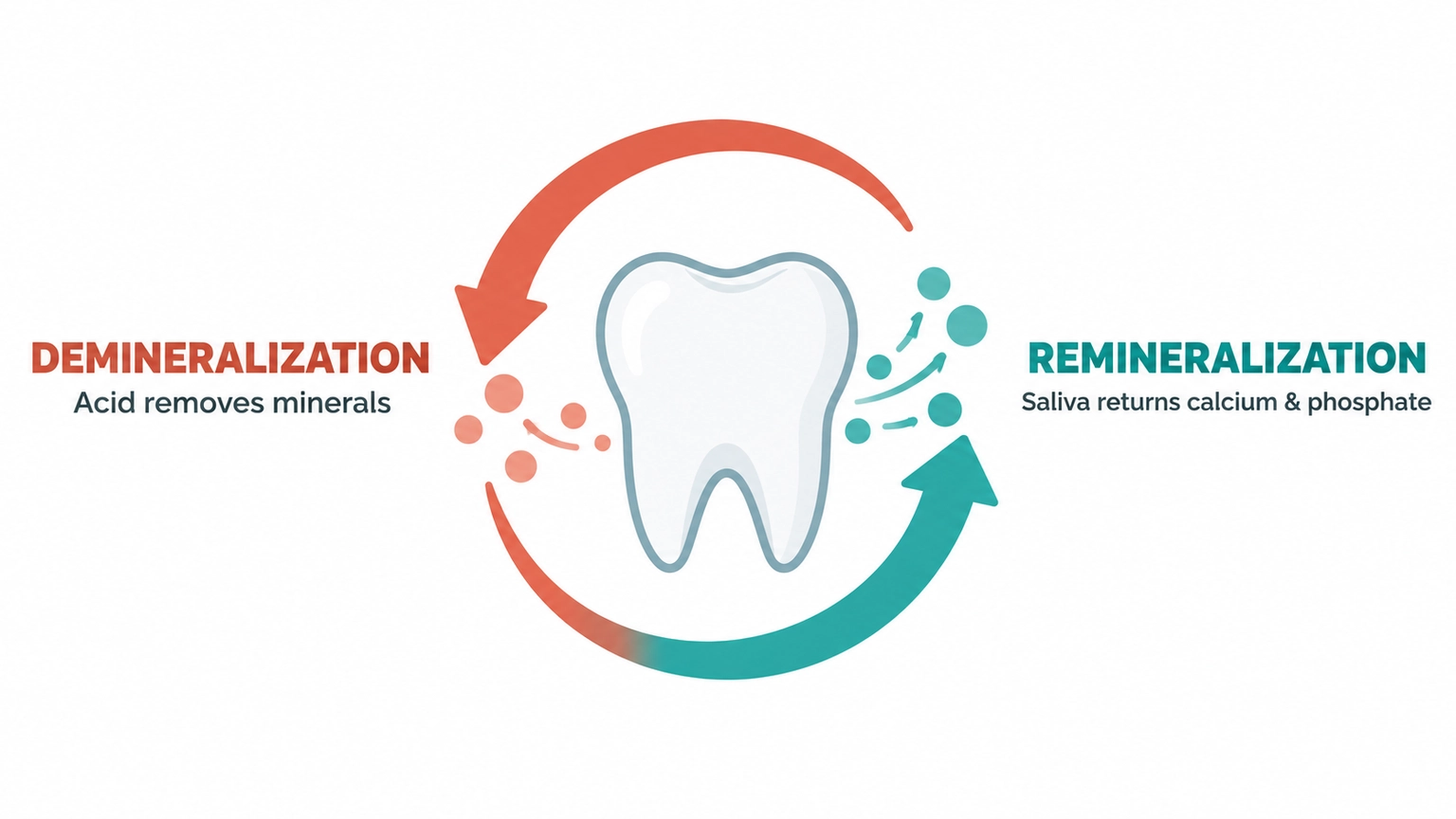
Tooth remineralization is the natural repair process for weakened enamel. Saliva carries calcium and phosphate to damaged areas of the tooth surface. Calcium and phosphate fill gaps in enamel’s crystal structure that acid left behind.
NIH research on enamel remineralization shows the repair moves through several mineral phases before hardening into finished enamel. Saliva carries more dissolved calcium and phosphate than it can hold in solution. That surplus flows back into enamel.
Demineralization and remineralization run in a constant cycle. Acid from food, bacteria, and drinks strips minerals out of enamel. Saliva puts them back.
The balance tips toward damage when acid exposure outpaces the repair rate.
Remineralization can reverse white spot lesions and early-stage decay. But it cannot restore enamel that acid or abrasion has physically removed.
Signs You May Need to Remineralize Your Teeth
Enamel mineral loss starts before you feel it. Most early signs of decay look cosmetic or go unnoticed until a dentist points them out.
Common signs you need remineralization:
- White or Chalky Spots: Dull white patches are the earliest visible signs of enamel mineral loss. Acid makes the subsurface layer porous beneath a surface that may still look smooth.
- Tooth Sensitivity: Sharp twinges when eating or drinking hot, cold, or sweet foods signal thinning enamel. The mineral layer has shrunk enough to expose dentin underneath.
- Translucent or Glassy Edges: The biting edges of front teeth turn see-through as enamel thins. Healthy enamel is opaque. Translucent edges mean the mineral layer no longer blocks light.
- Rough or Pitted Texture: Enamel that once felt smooth develops a gritty or uneven surface. Acid creates small pits and rough patches you can feel with your tongue.
- Dull or Yellow Appearance: Teeth lose brightness or shift toward yellow as thinning enamel reveals dentin beneath. Dentin is darker than enamel by default.
Sensitive teeth and visible white spots both signal that enamel erosion has started. Good oral hygiene and regular remineralization can reverse these signs before decay reaches dentin.
How to Remineralize Teeth Naturally
You remineralize teeth by feeding enamel lost minerals and keeping oral pH in a healthy range. Diet, the right toothpaste, steady saliva, and a few supplements each do part of that work.
Eat Mineral-Rich Foods
Calcium and phosphorus are the two essential minerals enamel needs to rebuild. Dairy products like cheese, yogurt, and milk deliver both in a bioavailable form.
Dairy raises calcium and phosphorus in plaque and supports remineralization, per an oral health review. Calcium also limits the rate of enamel repair more than any other mineral. Eating enough of it matters more than adding extra phosphate.
Dairy-free diets can still supply that calcium. Kale, spinach, almonds, and sesame seeds all deliver it in absorbable form.
Limit Acidic and Sugary Foods
Sugary and acidic foods drop oral pH below the 5.5 enamel damage threshold. Citrus, soda, and vinegar-based foods are the common offenders. Sugar feeds the bacteria that produce acid as a metabolic byproduct.
The American Dental Association recommends waiting 30–60 minutes after eating acidic foods before brushing. Acid softens the outer enamel layer temporarily. Brushing too soon wears away softened mineral that saliva would re-harden on its own.
Brush with Fluoride or Hydroxyapatite Toothpaste
Remineralizing toothpaste comes in two proven formulas. Fluoride converts enamel’s natural mineral into fluorapatite. Fluorapatite is a harder crystal that resists acid better than natural enamel.
Nano-hydroxyapatite (nHA) fills enamel pores with the same mineral teeth contain. Both formulas restore lost enamel hardness.
CariFree Gel 1100 combines fluoride and nHA. CariFree Fluoride-Free Gel uses nHA alone for those who prefer to avoid fluoride.
Use a pH-Neutralizing Mouth Rinse
Toothpaste strengthens enamel during brushing. That protection fades between meals. A pH-neutralizing rinse extends the safe window throughout the day.
After eating, acid drops pH low enough to erode enamel. Saliva restores safe levels on its own. But that recovery can take half an hour or longer.
A mouth rinse shortens the wait. CariFree Maintenance Rinse maintains oral pH levels and contains xylitol to cut acid output between meals.
Chew Xylitol Gum
Xylitol gum protects enamel in two ways. Chewing triggers extra saliva that raises pH and carries minerals to the tooth surface. The American Dental Association recommends chewing sugar-free gum for 20 minutes after meals to reduce decay risk.
Xylitol adds a benefit regular sugar-free gum lacks. The bacteria behind tooth decay feed on sugar to produce acid. They cannot digest xylitol. Without fuel, they produce less acid.
Stay Hydrated
Saliva is the body’s primary mineral delivery system for teeth. The National Institute of Dental and Craniofacial Research links dry mouth to higher tooth decay risk. Without enough saliva, acid lingers on enamel longer.
Rinse your mouth with water after meals to clear that acid and reset pH faster. NIDCR recommends drinking 8–12 cups of water daily to support saliva production.
Take Vitamin D and K2
Vitamin D drives calcium absorption from food into the body. A NHANES-based study found that people with severe vitamin D deficiency were 2.22 times more likely to have untreated cavities. That link held even after adjusting for sugar intake and BMI.
Vitamin K2 directs absorbed calcium toward teeth and bones rather than soft tissue. Pairing D3 with K2 supports the mineral pipeline that feeds enamel repair.
K2’s dental mechanism is still emerging in research. The vitamin D connection to lower cavity rates is well documented.
Apply Remineralizing Gel Before Bed
Saliva flow drops during sleep, and pH drops with it. The overnight hours are the weakest point in the mouth’s natural mineral delivery cycle.
Without saliva flow, acid from bacteria lingers on enamel for hours. A remineralizing gel at bedtime fills that gap. An NIH sleep study links reduced nighttime saliva flow to higher cavity risk.
CariFree Gel 1100 delivers minerals to your enamel through the night. The gel holds pH in the safe range when saliva flow drops. The riskiest hours become the strongest repair window.
Why Oral pH Decides Whether Repair Happens
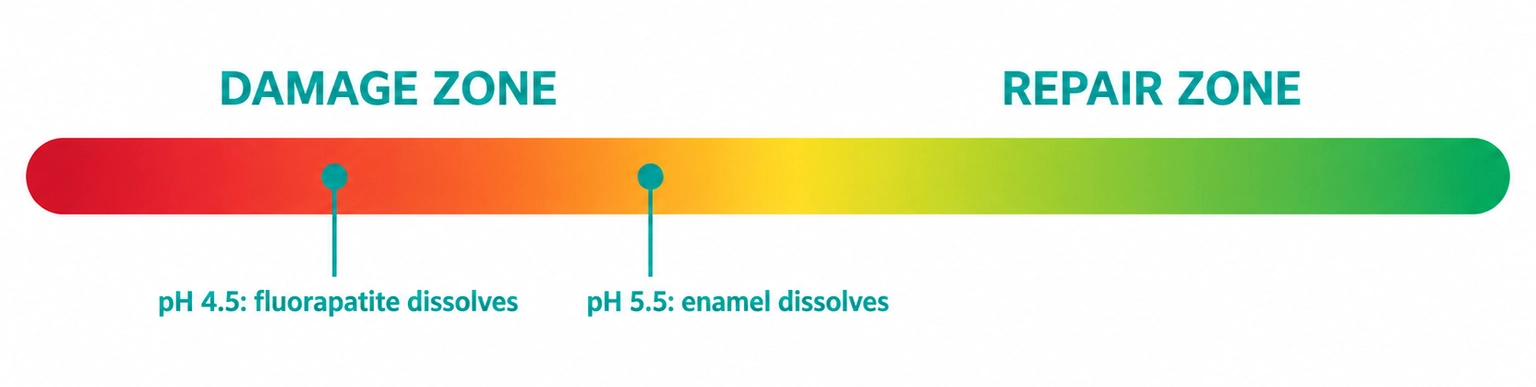
Every remineralization product shares one requirement. The mouth must stay in a safe pH range for enamel to rebuild.
Fluoride hardens enamel into fluorapatite, which resists acid down to pH 4.5. That buys roughly one extra pH point of protection. It does not make enamel immune to acid.
After eating, bacteria can drop plaque pH from a resting 7.0 to near 5.0 within minutes. Saliva needs 30–40 minutes to neutralize acids from plaque bacteria. Frequent snacking, dry mouth, and acid reflux extend the time enamel spends under attack.
CariFree tested this pH effect with an independent lab. In Intertek’s pH buffering study, untreated plaque pH dropped from 6.9 to 5.3 during a 20-minute sugar challenge. That is acidic enough to strip minerals from enamel.
CariFree-treated plaque held at pH 7.2 through the entire challenge. Treated plaque outperformed the control at every point in the test.
This explains why remineralizing products fail in some mouths. The environment stays too acidic for minerals to settle. Fixing oral pH comes first.
Learn more in the oral pH FAQ.
Does Remineralizing Toothpaste Work?
Remineralizing toothpaste works. Lab testing and clinical trials both confirm it.
In Intertek’s enamel remineralization study, CariFree’s nHA gel recovered 63% of lost enamel surface hardness. The control group recovered 38%. That is 67% more enamel repair over the same 3-day test period.
Faster hardness recovery means enamel resists the next acid attack sooner.
Clinical evidence supports these lab results at a larger scale. A randomized trial followed 171 adults for 18 months. Hydroxyapatite toothpaste prevented cavities at the same rate as fluoride toothpaste.
Nearly 90% of participants in both groups had zero new cavities. A separate study on children’s teeth confirmed that biomimetic hydroxyapatite performs comparably to fluoride.
Professor Elzbieta Paszynska co-led the 18-month adult trial. Paszynska described hydroxyapatite as a safe and effective fluoride alternative for daily use. The finding extends earlier pediatric evidence to adults.
Not all nHA products perform the same. Particle size, shape, and source affect outcomes.
CariFree uses nanoXIM from FLUIDNOVA, a 20 nm rod-shaped nHA with EU SCCS approval for oral care. CariFree founder Dr. Kim Kutsch co-authored the Compendium paper on nanoparticle hydroxyapatite.
For a deeper comparison of the two formulas, see the fluoride vs. hydroxyapatite guide.
How Long Does It Take to Remineralize Teeth?
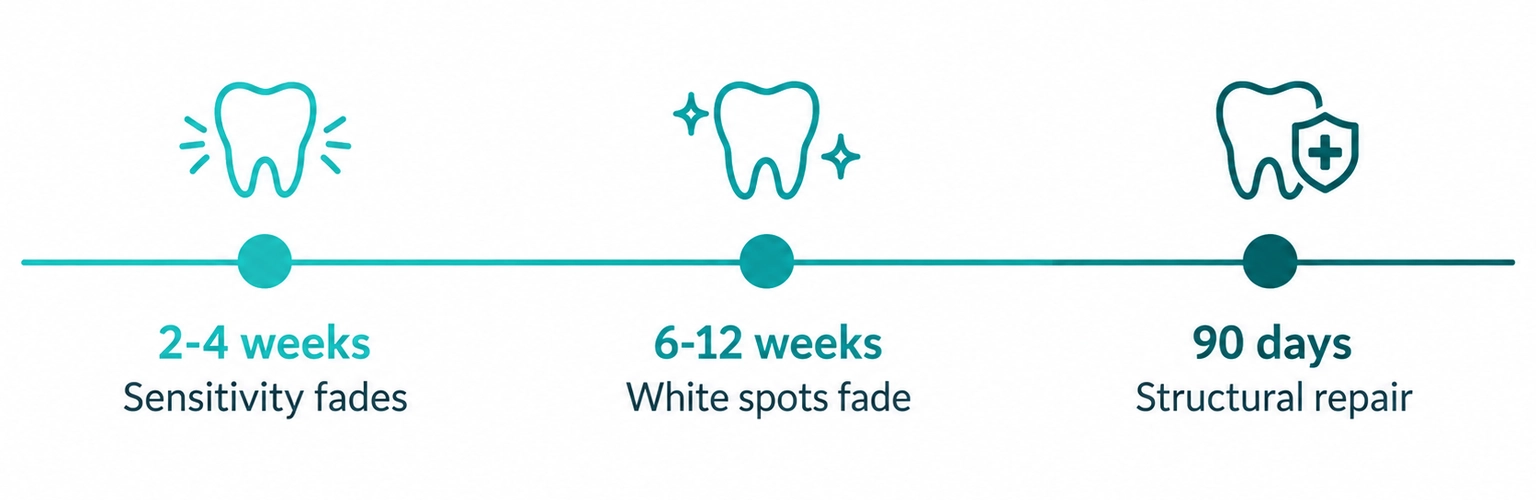
Teeth take 2 weeks to 3 months to remineralize. Sensitivity improves first, within 2–4 weeks. White spot repair and full structural hardening need 6–12 weeks of consistent daily care.
The exposed dentin tubules seal as new mineral layers form. Most people notice the difference within the first month.
White spot lesions take longer. Expect visible improvement at 6–12 weeks. Moderate white spots may need 3–4 months of treatment.
Full structural repair takes about 90 days for mineral crystals to organize into a dense, acid-resistant structure. A clinical study on CPP-ACP paste measured significant remineralization at both 6 and 12 weeks.
Repair compounds with continued use rather than plateauing early. Each week adds mineral density to the gains from the week before.
Every timeline above assumes two conditions. You use a remineralizing product every day and keep your mouth’s pH above 5.5.
Skipping days resets the repair cycle. When oral pH stays acidic, the remineralization process stalls regardless of the product.
Is Remineralizing Teeth Safe?
Yes, remineralizing teeth is safe. It is a natural process your saliva performs every day without any product. Remineralization products rely on two active ingredients: nano-hydroxyapatite and fluoride. Both have proven safety records at the amounts used in everyday products.
Nano-hydroxyapatite has an excellent safety profile. The EU Scientific Committee on Consumer Safety approved nHA in toothpaste at concentrations up to 29.5% in its 2025 final opinion. Everyday products use far less than the 29.5% ceiling.
Any nanoparticles a person swallows during normal use dissolve in stomach acid. Clinical studies report no adverse effects, even in children.
Fluoride is safe at toothpaste concentrations. The risk of fluorosis applies to children under 6 who swallow large amounts during tooth development. The CDC recommends a pea-sized amount for ages 3–6 and supervision to encourage spitting.
CariFree offers both options. Gel 1100 includes fluoride and nHA. The Fluoride-Free Gel uses nHA alone.
When to See a Dentist
Remineralization reverses early mineral loss. It cannot fix decay that has broken through enamel into dentin.
See a dental provider if you notice persistent pain, visible holes, or dark spots on a tooth. Early decay rarely causes pain.
The NIDCR notes that cavities caught during regular dental visits are far easier to treat. Dentists apply fluoride varnish at concentrations no over-the-counter product can match.
Ready for a professional evaluation? Find a dentist near you who carries CariFree to treat decay that at-home dental care cannot reverse.
Start Remineralizing Your Teeth with CariFree
Most remineralization products address symptoms. CariFree targets the cause. It replaces lost minerals and neutralizes the acid that strips them away.
The CariFree assessment quiz identifies your acid risk and matches you to the right oral care products.
FAQs About Tooth Remineralization
Find quick answers to common questions about ways to remineralize your teeth.
Does Fluoride Remineralize Teeth?
Fluoride does remineralize teeth by forming fluorapatite in weakened enamel. Fluorapatite makes enamel more resistant to acid and future mineral loss. CariFree Gel 1100 pairs fluoride with nano-hydroxyapatite to strengthen your teeth and prevent cavities.
Does Xylitol Remineralize Teeth?
Xylitol does not remineralize teeth directly. Xylitol reduces the acid-producing bacteria that damage enamel and boosts saliva flow. Your saliva then delivers the calcium and phosphate that repair early mineral loss. Xylitol works best with active remineralizing agents like fluoride or nano-hydroxyapatite.
Does Hydroxyapatite Remineralize Teeth?
Hydroxyapatite does remineralize teeth. Hydroxyapatite is the same mineral that makes up 97% of tooth enamel. Nano-hydroxyapatite (nHA) particles fill microscopic enamel pores and bond to the tooth surface. CariFree Fluoride-Free Gel uses nHA as its primary remineralizing agent.
Read next: The benefits of hydroxyapatite toothpaste.
Can Remineralization Reverse a Cavity?
Remineralization can reverse early-stage tooth decay but not a full cavity. White spots and surface-level mineral loss respond to consistent daily care. Decay that breaks through enamel into dentin needs a dental filling. Remineralization cannot regrow lost tooth structure.
Read next: Can You Reverse a Cavity?.
What Does Teeth Remineralization Look Like Before and After?
Teeth remineralization looks gradual, not dramatic. Weakened enamel starts with white spots, dull edges, or sensitivity. Weeks of consistent care fade the white spots and ease sensitivity as the surface re-hardens. It reverses early damage only. Full cavities and lost tooth structure need a dentist.
Do Teeth Remineralize Overnight?
Teeth do remineralize overnight, but saliva flow drops during sleep. Less saliva means fewer minerals reach enamel and acid lingers longer. A remineralizing gel before bed offsets this gap by keeping acid from dissolving enamel while you sleep.
This article is for general education and is not a substitute for professional dental advice. Talk to your dentist about diagnosis and treatment for your situation.